
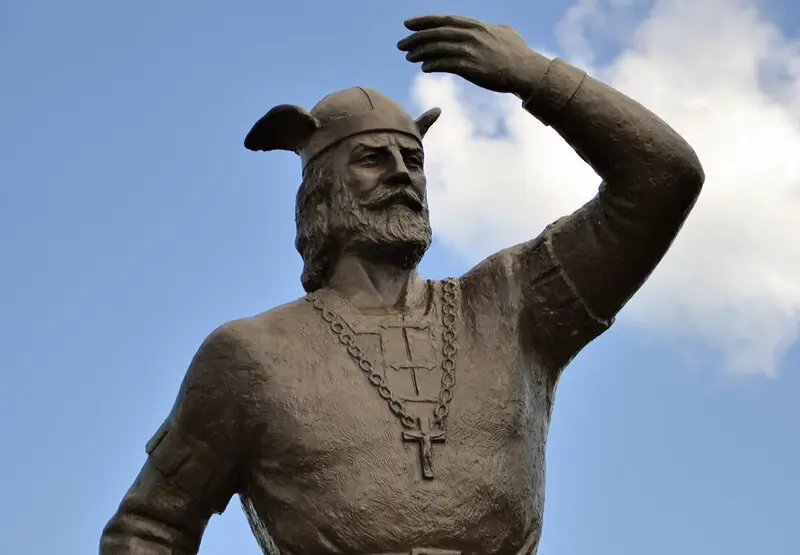
Amid the controversies over Columbus Day (Oct. 12), Leif Erickson Day (Oct. 9) seems to have flown under the radar. But it is a national holiday, so declared by Congress in 1935.
For centuries, the Viking expeditions to North America were shrouded by mystery, somewhere between history and legend. The old Viking sagas – notably the “Saga of Olaf Trygvasson,” the “Saga of Erik the Red,” the “Flateyjarbok,” the “Graenlendinga Saga,” and the “Kristni Saga” – told of a voyage to Vinland in the West. But were they credible?
The answer came in the early 1960s when Dr. Helge Ingstad discovered early settlements at L’Anse aux Meadows on the coast of Labrador. Norse artifacts from the site have been carbon dated to around A.D. 1000, the year of Erickson’s voyage. Thus, the Viking voyage to North America is now generally accepted.
Most people usually assume Erickson and his Viking colonists were pagan worshippers of Thor and Odin. But in fact, his voyage took place shortly after King Olaf Trygvasson brought Christianity to Norway and Iceland.
Erickson was the son of Erik the Red, who established the Norse colonies in Greenland in A.D. 985. As customary for the son of a chieftain, Erickson was sent to Norway to spend the winter in the court of King Olaf, who converted Erickson to Christianity. As “Eirik’s Saga” relates:
Once upon a time the king entered into conversation with Leif, and asked him, ‘Dost thou purpose sailing to Greenland in summer?’ Leif answered, I should wish so to do, if it is your will.’ The king replied, ‘I think it may well be so; thou shalt go my errand, and preach Christianity in Greenland.’ … Leif reached land in Eiriksfjordr, and proceeded home to Brattahlid. The people received him gladly. He soon after preached Christianity and catholic truth throughout the land, making known to the people the message of King Olaf Tryggvason; and declaring how many renowned deeds and what great glory accompanied this faith. Eirik took coldly to the proposal to forsake his religion, but his wife, Thjodhild, promptly yielded, and caused a church to be built not very near the houses. The building was called Thjodhild’s Church [I stood inside the ruins of Thjodhild’s Church in 1976 while on a backpacking expedition.]; in that spot she offered her prayers, and so did those men who received Christ, and they were many.
Erickson embarked on his voyage to the West to find lands that sailors had reported glimpsing. They first came upon a land they called Helluland (flat rock land, probably Baffin Island), then Markland (forestland, possibly Labrador), and then Vinland (vine-land, possibly Labrador, but also possibly as far south as New England). There they established a settlement and spent the winter, and the following spring they returned to Greenland.
The following year, Erickson’s brother Thorvald decided to explore Vinland more fully. He was mortally wounded when he and his men were attacked by Native Americans. He asked his men to take him to the headland of a river, saying, “[B]ury me there and put crosses at my head and my feet, and always called Krossanes [Place of Crosses] from now on.”
“Eirik’s Saga” and the “Graenlandinga Saga” tell of another relative of Erickson’s, Thorfinn Karlsefni, who established a colony using Erickson’s shelters around A.D. 1010. The colonists were mostly Christians, but at least two pagans were among them. Like the Pilgrims of 1620-21, the colonists underwent a period of starvation. According to “Eirik’s Saga,”
After that they called upon God, praying that He would send them some little store of meat, but their prayer was not so soon granted as they were eager that it should be. … A little while after a whale was driven ashore, and the men crowded round it, and cut it up …. Then began Thorhall and said, “Has it not been that the Redbeard [Thor] has proved a better friend than your Christ? [T]his was my gift for the poetry which I composed about Thor, my patron; seldom has he failed me.’ Now, when the men knew that, none of them would eat of it, and they threw it down from the rocks, and turned with their supplications to God’s mercy. Then was granted to them opportunity of fishing, and after that there was no lack of food that spring.
Like the Pilgrims, the Viking settlers included both Christians and pagans. Like the Pilgrims, the Viking settlers faced starvation. Like the Pilgrims, they stayed faithful to God. And like the Pilgrims, they received God’s blessing.
But unlike the Pilgrims, after only three years marked by trials and much bloodshed, they left and returned to Greenland.
Why did the Norse colony fail while Plymouth survived? I suggest that God did not bless the Viking colony because, although they themselves were mostly Christian, they showed almost no interest in evangelizing the native population and bringing them to Christ. They referred to the Indians and Eskimos with the scornful term skraelings (weaklings or barbarians) and their interactions were mostly hostile and violent.
By contrast, the Pilgrims and Puritans constantly evangelized the Wampanoag and other native tribes, with considerable success, as did the Jamestown colonists who arrived in 1607. And so did Christopher Columbus. As he wrote in his journal Oct. 12, 1492, concerning the natives he encountered on the island he named San Salvador (Holy Savior),
I, that we might form great friendship, for I knew that they were a people who could be more easily freed and converted to our holy faith by love than by force, gave to some of them red caps, and glass beads to put round their necks, and many other things of little value, which gave them great pleasure, and made them so much our friends that it was a marvel to see. … I believe that they would easily be made Christians, as it appeared to me that they had no religion….
Four days later he wrote, “They do not know any religion, and I believe they could easily be converted to Christianity, for they are very intelligent.”
The Spaniards, the French, and the English evangelized North America. Had the Vikings done so, the history of North America might have been very different. Still, we commend them for their intrepid voyage and for holding fast to Christianity.
America was born out of Christian evangelism. As we remember Leif Erickson Day and Columbus Day, let us never forget that.
Article originally posted October 7, 2026, on 1819 News. Used with permission.
Join the Conversation
We would love to hear from our readers and want to encourage positive interaction. Comments can
provide valuable feedback and encouragement to our writers, and this helps foster a sense of community. (Read our Comment Policy)
